Tel Aviv rally calls for coalition with Arab parties
- Arab-majority parties won a record 19 Knesset seats in the Oct. 27 election.
- The opposition and Arab parties together hold a potential 67-seat majority.
- Gadi Eisenkot has been tasked with forming the next government, but cooperation with Arab parties remains a major obstacle.
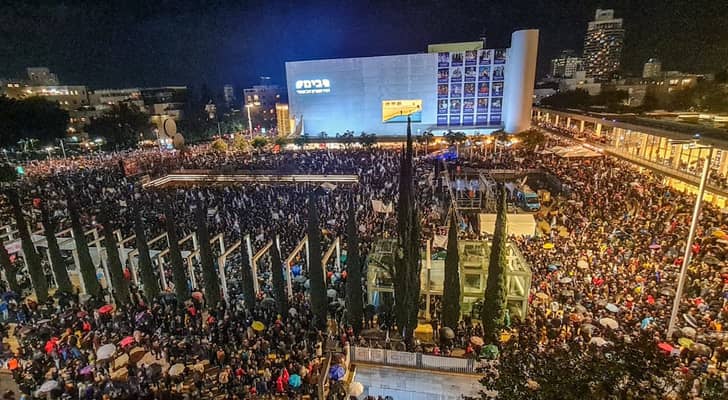
Protesters gathered at Habima Square in Tel Aviv on Saturday to demand the formation of a Jewish-Arab coalition government following ‘Israel’s’ general election, opposing Prime Minister Benjamin Netanyahu’s continued leadership and rejecting allegations that Arab voters had influenced the results improperly.
The demonstration brought together people calling for greater political cooperation between Jewish and Palestinian citizens of ‘Israel’, with protesters arguing that an Arab-Jewish partnership should be a legitimate part of the country’s political system.
Alon-Le Green, one of the demonstrators, accused Netanyahu of attempting to undermine the election results by suggesting that the vote had been rigged and that Arab voters had stolen votes.
“Netanyahu is trying to steal the elections by saying that they were rigged and that the Arab voters stole the votes. We are here to say no,” Green said.
“I think it is only normal to have an Arab-Jewish coalition in an Arab-Jewish society,” he added.
The rally comes amid a political deadlock following the Oct. 27 election, in which Netanyahu’s Likud-led bloc won 53 seats in the 120-member Knesset, short of the 61 needed for a parliamentary majority.
The two Arab-majority parties, the Joint List and Ra’am, secured a combined 19 seats, their strongest showing to date. Together with the four Jewish-led opposition parties, which won 48 seats, they give the anti-Netanyahu camp a potential 67-seat majority. However, most opposition leaders have been reluctant to form a government that includes or depends on Arab parties.
The election results have also intensified tensions over the political role of Palestinian citizens of ‘Israel’. Likud and other right-wing figures have accused Arab parties of attempting to influence the election through alleged vote-buying and other irregularities. However, the Central Elections Committee and police have reported finding no evidence of organised electoral tampering.
On Nov. 7, President Isaac Herzog selected opposition leader Gadi Eisenkot to try to form the next government, after he received the most recommendations from lawmakers. The decision places renewed attention on whether he will seek cooperation with the Arab-majority parties to replace Netanyahu.
Netanyahu, meanwhile, has called for a unity government, warning against an alternative administration that relies on Arab parties, whom he described as Islamists. His appeal has been rejected by Eisenkot’s camp.
The demonstrations in Tel Aviv reflect a broader debate over whether Palestinian citizens of ‘Israel’, who make up roughly one-fifth of the population, should have a meaningful role in national political decision-making.