Why water rights will become the asset class of the 21st century
For a century, the resource that shaped global politics was oil. The next contest is forming around something the market has never properly priced: water.
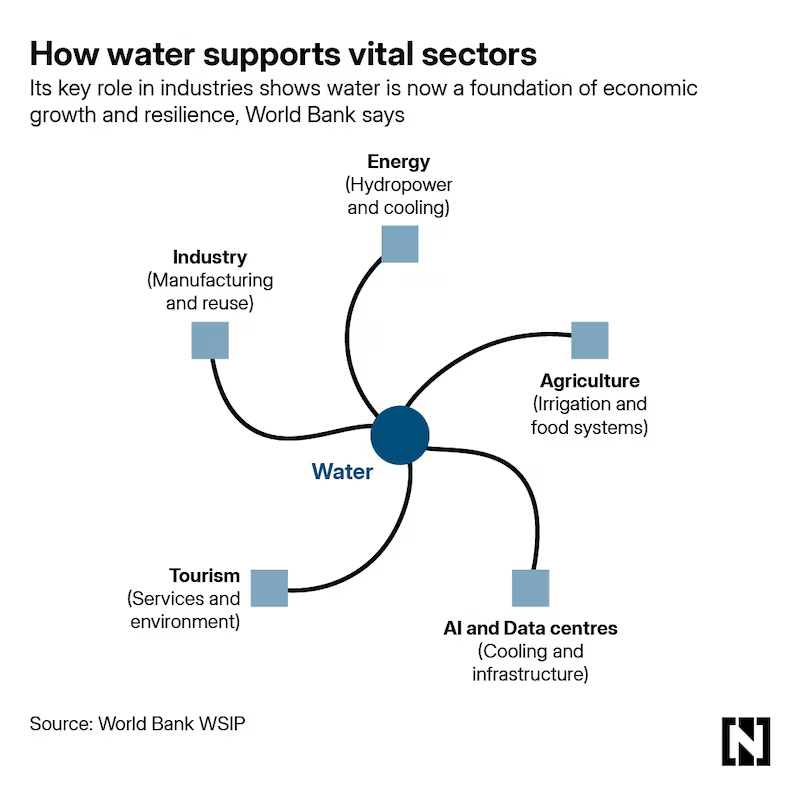
A semiconductor fabrication plant can use about 37.8 million litres of ultra-pure water a day, equal to 33,000 US households. TSMC used 101 million cubic metres in 2023, and chip-related water demand is expected to double by 2035. Data centres used about 560 billion litres in 2024 and could reach 1.2 trillion by 2030. Agriculture still accounts for about 70 per cent of global withdrawals.
Water has stopped being the invisible utility beneath the global economy. It is becoming the binding constraint on it. That is the central investment point: in many places, water is no longer merely a cost input. It is becoming the permission slip for growth.
The macro picture is well rehearsed. The UN projects that global freshwater demand could exceed supply by 40 per cent by 2030. The World Resources Institute expects the Middle East and North Africa to face “extremely high water stress” by 2050. Governments and capital allocators are starting to treat water less as a public service and more as a strategic asset.
Water market takes shape
Unlike oil, gold or wheat, water has lacked a functioning global market with transparent prices and tradable contracts. That is changing. The global water and wastewater services sector is projected to exceed $1 trillion by 2033, with value sitting in water rights, infrastructure, technology, utilities and finance.
Australia’s Murray-Darling Basin operates the world’s most developed water market, with annual turnover of about A$4 billion ($2.86 billion) and entitlements valued near A$30 billion in 2024. In the western US, agricultural water has long traded near $20 an acre-foot, while urban and industrial buyers have paid $700 to $2,500. One development near the Grand Canyon was reportedly prepared to pay $20,000.
An acre-foot used in California semiconductor manufacturing has been estimated to generate close to $980,000 in state revenue. The same acre-foot used for cotton or alfalfa generates about $60. As that spread widens, water rights begin to behave like development rights: portable, finance-able and licensed.
Infrastructure is the second layer. GCC water investment is set at $76 billion, desalination capacity is expected to rise 37 per cent in five years, and total public-private spending could reach $100 billion, including $32 billion for desalination by 2027. America’s water infrastructure investment gap is about $744 billion over the next two decades.
Then come technology and finance: reuse systems, membrane filtration, precision irrigation, listed utilities, indices, futures and tokenised water assets. They allow institutional capital to take a position in water without touching a pipeline.
The argument is not that water should be financialised without limits. It is that scarcity is already creating value, and markets are beginning to recognise it.
The countries moving first
National strategies are diverging. China is investing in recycling and acquiring farmland abroad, importing “virtual water” through grain. The Middle East has chosen infrastructure, accounting for 46.9 per cent of global contracted desalination capacity and 41.8 per cent of operational capacity. It also generates more than half of global brine output, a reminder that even technological solutions carry environmental costs.
Global water sector financing breakdown
Heavy reliance on public funding highlights the urgent need to bring in private investment to meet rising demand, World Bank says
The US is dealing with depletion. The Ogallala aquifer is shrinking, the Colorado basin is under structural shortage, and data-centre water use hit an estimated 798 billion litres in 2023. Israel has taken the commercial route, with water technology now about a $2 billion annual export industry. Singapore has built a closed-loop water economy around its NEWater programme.
Exposed countries are treating water as a sovereign asset to be priced, protected and, increasingly, traded.
The economic transmission is already visible. Morocco’s 2023 rainfall decreased about 28 per cent, agricultural output fell about 20 per cent and wheat-import dependence deepened. Tunisia’s cereal harvest collapsed by 80 per cent in the same cycle. The World Bank estimates that water scarcity could shave 6 to 14 per cent off Mena GDP by 2050.
Beyond agriculture, water shortages slow power, mining and refining, force chip fabricators and data centres to relocate or invest in reclamation, and feed through to industrial costs and inflation. That creates clearer winners and losers: countries with capital, geography or technology on one side; import-dependent economies, low-margin farmers and late-moving governments on the other.
The risks are real. Making water can encourage speculation, concentrate ownership and worsen access during droughts. Any credible system will need safeguards on essential human use and a clear separation between speculation and physical delivery.
But the direction of travel is set. Water security is no longer a distant climate problem. It is an economic one. The choice is not between markets and morality. It is between designing rules before scarcity bites, or letting scarcity design them for us.
If oil defined the geopolitical order of the 20th century, water sovereignty will help define the economic order of the 21st. And unlike oil, there is no substitute.