

US Air Force officer charged after protesting Trump
- Air Force Major Jason Watson defended his calls for impeachment during an Article 32 hearing, framing public dissent as an oath-bound duty.
- Watson faces 10 counts—including Article 88 contempt against officials—stemming from a Capitol protest, interviews, and online posts.
- Defense lawyers cited the extreme rarity of Article 88 cases, arguing Watson faces selective enforcement relative to past military dissenters.
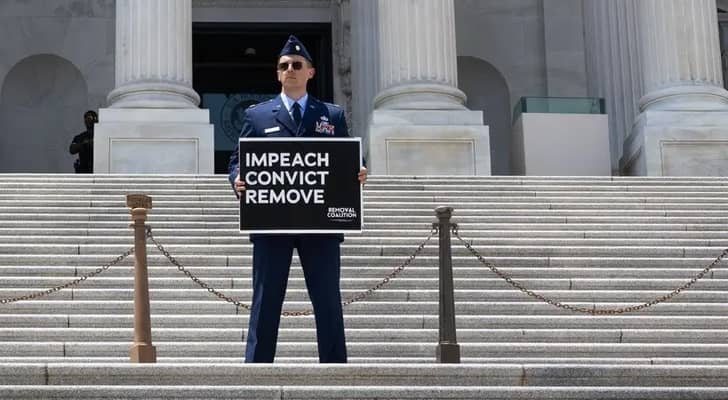
An active-duty US Air Force officer arrested in uniform at the US Capitol after calling for President Donald Trump’s impeachment delivered an unsworn statement in court on Friday, arguing that his public dissent was driven by a sworn duty to defend the Constitution.
Major Jason Watson made his comments during a four-hour Article 32 hearing, an initial military justice proceeding that assists in determining whether charges should proceed to a formal court-martial.
Military prosecutors argued during the proceeding that Watson had violated military regulations and betrayed the Constitution by mounting “vitriolic attacks on the character of the president.”
Delivering an unsworn statement -an uncommon move for a defendant during an Article 32 proceeding- Watson told the investigating officer, Major Joshua Wendell, that his actions were rooted in principled obligation rather than political partisanship.
“I spoke to change something I believed was wrong, in the open, under the weight of my own name and my own oath,” Watson told the court.
Capitol arrest
The charges against Watson stem from a series of public statements and actions protesting executive policy decisions.
In July, Watson was arrested during a protest at the US Capitol, where he publicly accused US President Trump of repeatedly violating the Constitution.
During the demonstration, he specifically pointed to military actions in Iran and Venezuela, an ongoing widespread immigration enforcement crackdown, and the dismantling of federal government agencies.
In August, Watson appeared on broadcast television for an interview with CNN anchor Erin Burnett, reiterating his critiques, stating that the president had failed the nation, and expressing hope that his protest would inspire public action.
According to Watson’s attorney, Christopher Mutimer, the airman was detained on his base the day after the CNN interview after reporting for duty and informing his chain of command that he would no longer wear his uniform.
Watson has remained in pretrial confinement since that day.
Prosecutors also allege that Watson was the author of an anonymous June 2025 Substack post that described US President Trump as “a greedy, unintelligent, narcissistic, pathological liar, traitor, and coward.”
Extremely rare Article 88 charges
Major Wendell, who presided over Friday’s hearing, noted that the case highlights the fundamental “tension between First Amendment rights and your obligations as a military officer.”
Active-duty service members are bound by strict prohibitions regarding public political dissent while in uniform.
Prosecutions under Article 88 for “contempt toward officials” are exceptionally rare in modern military history.
Daniel Maurer, a retired Army Lieutenant Colonel and Judge Advocate now teaching law at Ohio Northern University, noted that only two convictions under Article 88 have occurred since the Uniform Code of Military Justice was established in 1951:
- Lt. Henry Howe (1965): Convicted after carrying a sign during an anti-Vietnam War protest that labeled President Lyndon B. Johnson’s actions as fascist.
- Lt. Col. Stuart Scheller (2021): Active-duty Marine who posted social media videos criticizing the Biden administration’s handling of the U.S. military withdrawal from Afghanistan.
Scheller’s case was resolved through a special court-martial where he pleaded guilty, received a letter of reprimand, forfeited $5,000 in pay, and resigned his commission.
His videos were previously praised by Pete Hegseth, who later brought Scheller on as a senior adviser in the Pentagon after becoming Defense Secretary.
Watson’s defense team cited the handling of Scheller’s case throughout Friday’s hearing, arguing that the government had established a precedent and that Scheller’s offenses were far more severe and involved more numerous charges than Watson’s.
“Can this prosecution be squared with the evenhanded administration of justice?” Mutimer asked the court, adding that “what he did, in the end, was speak.”
Major Wendell is expected to issue a recommendation later this month regarding whether the case should advance to a court-martial, and whether it should be referred as a special court-martial (equivalent to a misdemeanor court) or a general court-martial (equivalent to a felony court).
During the four-hour hearing, a member of the public was removed from the courtroom following a brief verbal interjection.