


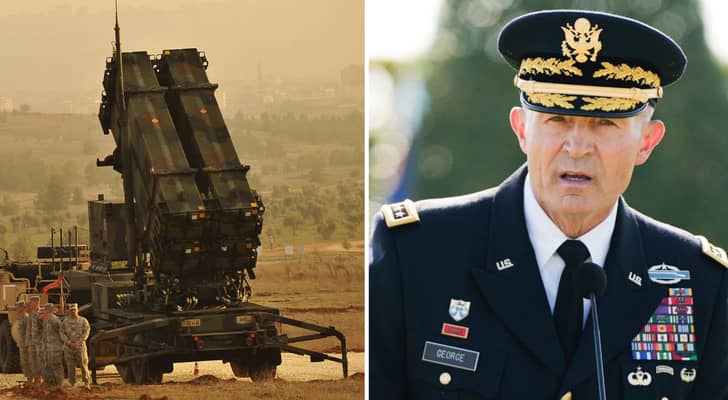
Ousted US Army chief warned of “critical” missile defense shortage before Iran war: report
Former US Army Chief of Staff Gen. Randy George warned that the Army was “critically short” on missile defense munitions and that the shortage would persist for another five years, according to multiple US officials cited by CBS News.
The warning came in late December 2025, two months before the US-‘Israeli’ war with Iran began.
George’s risk analysis was included in the Pentagon’s Global Force Management Allocation Plan for fiscal year 2027, the annual order that allocates troops and weapons worldwide.
He specifically flagged that stockpiles of Terminal High Altitude Area Defense (THAAD) interceptors and Patriot missiles would remain at strategically low levels until 2030.
Defense Secretary Pete Hegseth ousted George in April 2026 while the conflict was underway.
Officials said the assessment stemmed from Patriot transfers to Ukraine after Russia’s 2022 war, munitions expended defending ‘Israel’, and reduced capacity in the defense industrial base.
US officials told CBS that while the military still holds significant stocks of some offensive munitions such as Joint Direct Attack Munitions and Small Diameter Bombs, missile defense interceptors for THAAD and Patriot systems sit at low strategic-risk levels.
One official noted that even without further expenditures, restoring stockpiles merely to the already-low December 2025 levels would take until 2030.
Estimates from the Center for Strategic and International Studies (CSIS) illustrate the scale of the drawdown.
The US entered 2026 with roughly 2,300 Patriot interceptors and expended between 1,050 and 1,430 during the Iran war—potentially as much as 61% of the prewar inventory.
THAAD stocks stood at about 355 interceptors before the conflict, with 190 to 290 used, or roughly 82% of the prewar total.
Fewer than 500 Patriot replenishments were expected in fiscal 2026, and no THAAD deliveries were planned that year.
“Those are the two Army munitions that would be most heavily used in a conflict with China,” said Mark Cancian, a retired Marine colonel and CSIS senior adviser.
“You’re not gonna use that many Javelins, for example, because the amount of ground combat is going to be relatively limited, even artillery will be limited, but air defense—missile defense—that will be huge.”
Production timelines remain lengthy: new THAAD interceptor contracts take more than four years to fulfill, while Patriot PAC-3 orders average three and a half years.
Decades of post-Cold War planning, industrial consolidation, and prioritization of platforms over munitions contributed to the shortfalls, Cancian explained.
“After the Cold War, we planned on fighting short regional conflicts… We needed much smaller inventories… We squeezed all the surge out because it was seen as unnecessary.”
Lockheed Martin has announced plans to expand THAAD production from 96 to 400 interceptors per year, and the US has requested more than 800 THAADs for fiscal 2027.
Pentagon chief spokesman Sean Parnell rejected the shortage claims.
“Claims of U.S. munitions shortages are false. When the Fake News media irresponsibly amplifies these lies, the real-world consequences is clear: our enemies are emboldened to provide—or attack—American troops,” he said.
Parnell added that the US retains “everything required to strike at the time and place of the President’s choosing” and maintains “a deep, ready arsenal to defend our people and our interests.”
